
Last Updated on May 11, 2026
💰 Quick Answer:
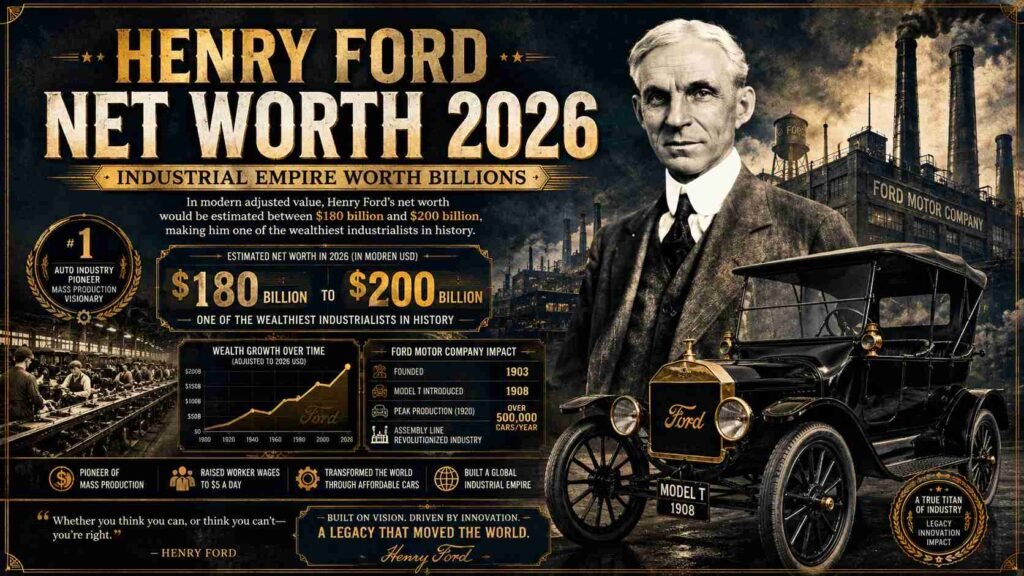
In modern adjusted value, Henry Ford’s net worth would be estimated between $180 billion and $200 billion, making him one of the wealthiest industrialists in history.
The story of Henry Ford net worth is more than just a tale of wealth it is the story of modern industrial America. Henry Ford transformed transportation, manufacturing, and business forever through innovation and mass production.
As the founder of Ford Motor Company, Henry Ford helped create the modern automobile industry while building one of the largest personal fortunes of the 20th century. His revolutionary assembly-line manufacturing system changed how products were made worldwide and turned automobiles from luxury items into products accessible to everyday people.
Although Ford passed away in 1947, discussions about his wealth remain fascinating because his fortune, adjusted for inflation and economic growth, would place him among the richest people in modern history.
This article explores Henry Ford’s wealth, business empire, assets, philanthropy, and how his fortune compares to today’s billionaires.
Bio Data Table
| Attribute | Details |
|---|---|
| Full Name | Henry Ford |
| Date of Birth | July 30, 1863 |
| Age (as of 2026) | Would be 163 years |
| Place of Birth | Dearborn |
| Nationality | American |
| Height | Approx. 5 ft 10 in |
| Weight | Approx. 78 kg |
| Health Conditions | Experienced age-related illness later in life |
| Religion | Christian |
| Education | Limited formal education |
| Sports | N/A |
| Zodiac Sign | Leo |
| Marriage Status | Married to Clara Ford |
| Children | 1 son (Edsel Ford) |
| Net Worth (Modern Estimate) | $180B – $200B |
| Famous For | Founder of Ford Motor Company |
| Still Alive | No |
| Died | April 7, 1947 |
Who Is Henry Ford? Background & Early Life
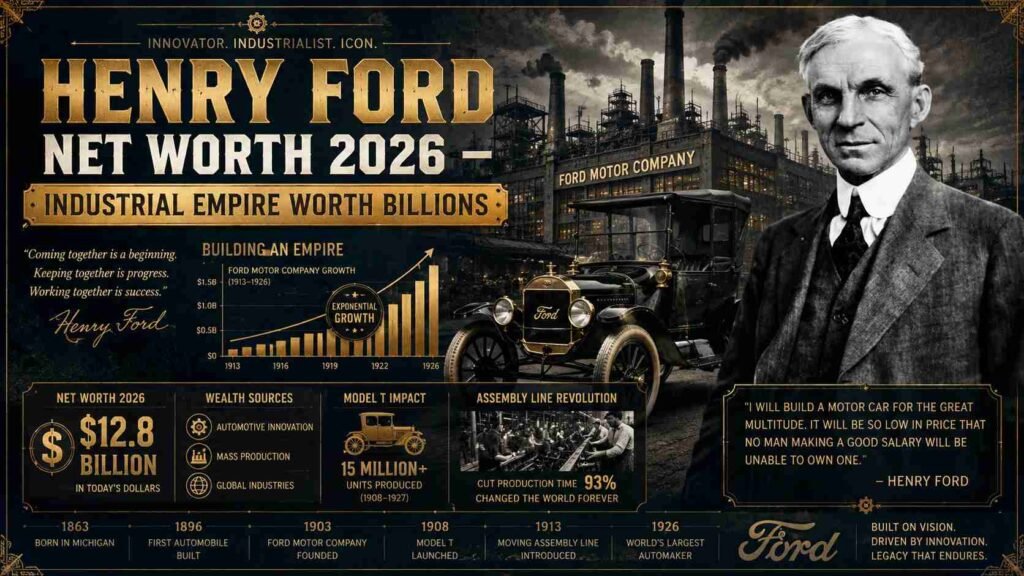
Henry Ford was born on a farm in Michigan during a time when America was still largely rural. From a young age, he showed a fascination with machinery and mechanical systems.
Unlike many industrialists of his era, Ford did not come from inherited wealth. His success was built through engineering skill, persistence, and business innovation.
As a teenager, he worked with watches, engines, and farm equipment before becoming an engineer at Edison Illuminating Company. His experiences there gave him the confidence and technical knowledge needed to pursue automobile manufacturing.
Ford believed transportation should be affordable for ordinary people a philosophy that would eventually create one of the most valuable industrial businesses in history.
Disclaimer: Net worth figures are estimates based on historical financial data and inflation-adjusted calculations and may vary.
Net Worth Overview
Estimating Henry Ford net worth in today’s dollars requires inflation adjustment and comparison to modern economic influence.
At the peak of his wealth during the 1920s and 1930s, Henry Ford controlled a massive percentage of the automobile industry through his ownership stake in Ford Motor Company.
Financial historians estimate that:
- His inflation-adjusted fortune exceeded $180 billion
- Some economic comparisons place it above $200 billion
- At his peak, Ford was one of the richest private individuals ever recorded
Unlike modern billionaires whose wealth is tied heavily to stocks and digital technology, Ford’s fortune came from:
- Manufacturing dominance
- Industrial ownership
- Factory infrastructure
- Automobile production
- Global exports
His wealth represented real industrial power during America’s manufacturing boom.
Net Worth Growth Timeline
Before Fame
Before becoming wealthy, Ford worked modest jobs as:
- A machinist
- Farm assistant
- Mechanical engineer
During this stage, he experimented with engines and prototypes in small workshops.
Breakthrough Phase
Ford’s breakthrough came with the founding of Ford Motor Company in 1903.
The launch of the Model T changed the world. Unlike luxury automobiles made for the wealthy, the Model T was designed for affordability and durability.
This approach exploded Ford’s sales and rapidly increased his fortune.
Peak Wealth Years
By the 1920s, Ford Motor Company became one of the largest industrial corporations globally.
Key financial milestones included:
- Massive automobile sales
- International factory expansion
- Vertical integration of production systems
- Ownership of steel, rubber, and manufacturing operations
At this stage, Henry Ford’s wealth rivaled modern tech billionaires in economic influence.
Later Years
Although competition increased later in his life, Ford remained extraordinarily wealthy until his death in 1947.
His family retained influence through:
- Ownership structures
- Voting control within Ford Motor Company
- Long-term investment holdings
Main Sources of Income
Automobile Manufacturing
The largest source of Henry Ford’s wealth came from automobile production.
Ford Motor Company dominated the market because of:
- Affordable pricing
- Mass production efficiency
- Reliable engineering
Millions of vehicles sold globally created enormous recurring profits.
Assembly Line Innovation
Ford’s moving assembly line revolutionized manufacturing economics.
This innovation allowed:
- Faster production
- Lower labor costs per vehicle
- Higher output
- Increased profitability
The assembly line became one of the most valuable industrial innovations ever created.
Global Expansion
Ford expanded internationally into:
- Europe
- South America
- Asia
International factories and exports dramatically increased company revenue and personal wealth.
Ownership & Equity
Unlike many executives today, Henry Ford maintained significant ownership control over his company.
This ownership allowed him to accumulate wealth through:
- Corporate profits
- Equity appreciation
- Industrial assets
Business Strategy Behind the Wealth
Henry Ford’s wealth strategy focused on scale and efficiency.
His key business principles included:
Mass Production
Producing products at large scale lowered costs and increased margins.
Affordability
Ford understood that lower prices could create larger markets.
Instead of targeting elites, he targeted ordinary workers.
Vertical Integration
Ford controlled:
- Raw materials
- Factories
- Transportation
- Distribution
This reduced dependency on suppliers and increased profits.
Worker Productivity
Ford famously introduced the $5 workday, dramatically increasing wages for factory workers.
This strategy:
- Reduced turnover
- Increased productivity
- Allowed workers to buy Ford cars themselves
It was revolutionary for the time.
Awards & Achievements and Financial Impact
Henry Ford’s achievements reshaped the world economy.
Major accomplishments include:
- Popularizing automobiles globally
- Revolutionizing manufacturing systems
- Influencing modern labor practices
- Building one of history’s largest industrial companies
The financial impact of these innovations created generational wealth for the Ford family.
Assets & Lifestyle
Real Estate
Ford owned:
- Large estates in Michigan
- Industrial facilities
- Massive factory complexes
His properties represented enormous industrial value.
Factories & Industrial Assets
Unlike celebrity billionaires who own luxury brands or tech stocks, Ford’s assets were heavily industrial.
These included:
- Manufacturing plants
- Steel operations
- Transportation infrastructure
Personal Lifestyle
Despite immense wealth, Ford was known for relatively conservative personal habits.
He focused more on:
- Business growth
- Engineering
- Production systems
rather than excessive luxury.
Net Worth Comparison (Historical & Modern)
| PersonEstimated Net Worth | |
|---|---|
| John D. Rockefeller | $300B+ (modern estimate) |
| Henry Ford | $180B–$200B |
| Elon Musk | Modern fluctuating billionaire range |
| Jeff Bezos | Modern fluctuating billionaire range |
Henry Ford remains one of the richest industrialists ever when adjusted for inflation.
Controversies, Challenges & Financial Risks
Henry Ford’s legacy is complex.
Challenges included:
- Labor disputes
- Anti-union policies
- Competitive pressure from General Motors
- Public criticism over personal beliefs and publications
These controversies impacted public perception but did not erase his industrial success.
Philanthropy & Social Impact
Ford’s influence extended beyond business.
The Ford family later became associated with major philanthropy through:
- Educational funding
- Public institutions
- Cultural preservation
- Scientific research
His innovations also improved everyday life by making transportation accessible to millions.
How Henry Ford Made Money Outside Core Business
Beyond automobiles, Ford generated income from:
- Steel production
- Rubber plantations
- Timber operations
- Transportation logistics
- Industrial land ownership
This diversification strengthened his fortune significantly.
Future Net Worth Projection (Legacy Value)
Although Henry Ford is no longer alive, the Ford legacy continues through:
- Family ownership influence
- Brand recognition
- Corporate growth
- Historical economic significance
If Ford’s original ownership stakes were valued fully in modern terms, analysts believe the family’s industrial influence would still rank among America’s greatest fortunes.
Frequently Asked Questions
1. What was Henry Ford’s net worth in today’s money?
Henry Ford’s modern adjusted net worth is estimated between $180 billion and $200 billion.
2. How did Henry Ford become rich?
He became wealthy through automobile manufacturing and founding Ford Motor Company.
3. Was Henry Ford richer than modern billionaires?
Adjusted for inflation, he ranks among the richest industrialists ever.
4. What was Henry Ford’s biggest invention?
The moving assembly line and affordable mass-produced automobiles.
5. Does the Ford family still own Ford Motor Company?
The Ford family still maintains voting control through special share structures.
6. What made Ford Motor Company successful?
Affordable cars, efficient manufacturing, and large-scale production.
Conclusion
The story of Henry Ford net worth is ultimately a story about industrial transformation. From a farm boy in Michigan to one of history’s richest businessmen, Henry Ford reshaped transportation, manufacturing, and modern capitalism.
His estimated modern fortune of $180–$200 billion reflects not only personal wealth but also the enormous economic influence he held during America’s industrial rise.
More than a businessman, Henry Ford was a system builder whose innovations still shape global manufacturing today. His legacy remains deeply connected to industrial progress, mass production, and the idea that technology should be accessible to ordinary people.

Tyler Johnson is a wealth storyteller at WealthFlint.com, turning numbers into fascinating insights. From net worth figures to career earnings, he brings the financial journeys of successful personalities to life, helping readers understand how fortunes are made and grown.