
Last Updated on April 22, 2026
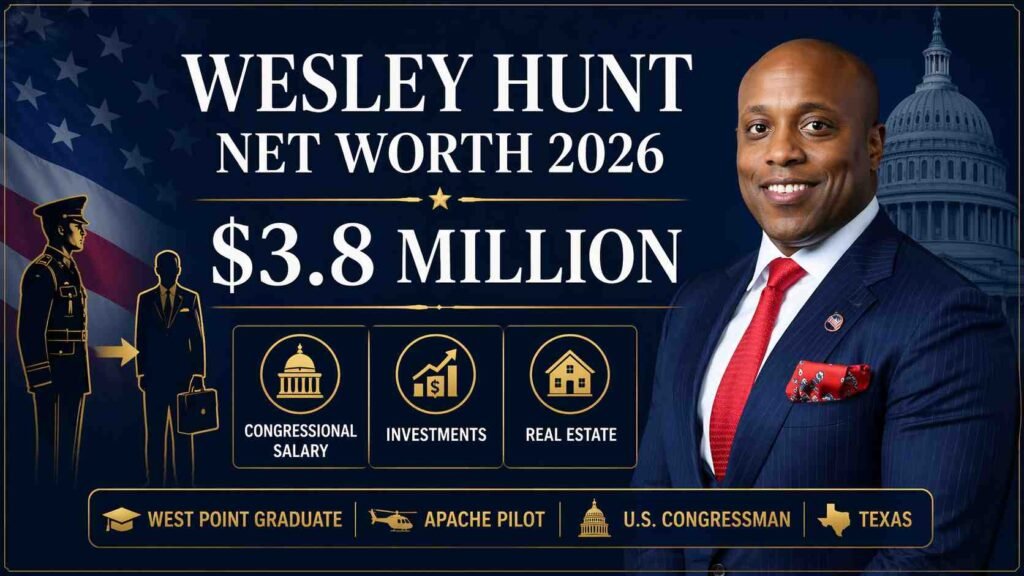
What does financial success built entirely on discipline, service, and academic excellence actually look like? Wesley Hunt net worth in 2026 answers that question in a way that few Washington politicians can match. As of early 2026, Hunt’s estimated fortune sits at approximately $3.8 million a figure independently tracked by financial analytics firm Quiver Quantitative.
He didn’t stumble into it through a corporate windfall. He built it, one deliberate career move at a time, from West Point to Baghdad to Capitol Hill. For anyone curious about how a decorated Army veteran, holder of three graduate degrees, and sitting U.S. Congressman from Texas manages money in public life, Hunt’s financial story is genuinely instructive.
Disclaimer: Net worth figures are estimates based on publicly available data and financial disclosure reports and may vary. This article is intended for informational purposes only.
Bio Data Table
| Detail | Information |
|---|---|
| Full Name | Wesley Parish Hunt |
| Date of Birth | November 13, 1981 |
| Age (2026) | 44 years old |
| Birthplace | Houston, Texas, USA |
| Nationality | American |
| Ethnicity | African American |
| Religion | Baptist |
| Spouse | Emily Hunt |
| Children | Including son Willie (born ~2023) |
| Education | West Point (B.S., 2004); Cornell University (MBA, MPA, MILR) |
| Profession | U.S. Congressman, Former U.S. Army Officer |
| Political Party | Republican |
| Congressional District | Texas’s 38th Congressional District |
| Served in Congress Since | January 2023 |
| Estimated Net Worth (2026) | ~$3.8 million |
| Net Worth Ranking in Congress | ~194th–195th highest |
Who Is Wesley Hunt? Background & Early Life
Wesley Parish Hunt was born on November 13, 1981, in Houston, Texas, into a military family where discipline wasn’t a suggestion it was the household default. He attended St. John’s School in Houston, one of the city’s most academically rigorous prep institutions, and distinguished himself enough to earn an appointment to one of the most selective colleges in the country: the United States Military Academy at West Point.
He graduated from West Point in 2004 with a Bachelor of Science in Leadership and Mechanical Engineering the same class that produced fellow Republican congressmen John James and Pat Ryan. That shared graduating class speaks to a generation of service-minded leaders who translated military careers into political ones. Upon commissioning, Hunt flew Apache helicopters for the U.S. Army over the next eight years. His service included one deployment to Iraq, where he flew 55 combat air missions, and two tours to Saudi Arabia as a Diplomatic Liaison Officer.
By 2012, Hunt had transitioned out of the Army as a Captain. Rather than coast on his military résumé, he enrolled at Cornell University and earned not one, not two, but three graduate degrees an MBA, a Master of Public Administration (MPA), and a Master of Industrial and Labor Relations (MILR). That triple-degree combination is almost unheard of in political circles and gave him a rigorous intellectual foundation in business, governance, and labor economics that most politicians simply lack.
Hunt made his first run for Congress in 2020, competing for Texas’s 7th Congressional District. He won the Republican primary convincingly but narrowly lost the general election to incumbent Democrat Lizzie Fletcher. Undeterred, he repositioned himself for the newly drawn 38th Congressional District a solidly Republican seat that, according to analysts, was carved out with him in mind. He won the 2022 general election with 63% of the vote, entering Congress in January 2023. In October 2025, he announced a run for the U.S. Senate seat representing Texas in 2026, though he ultimately placed third in the Republican primary behind incumbent John Cornyn and Attorney General Ken Paxton.
Net Worth Overview
Wesley Hunt’s net worth in 2026 is estimated at approximately $3.8 million, according to Quiver Quantitative’s ongoing tracking of congressional financial disclosures. This places him roughly 194th to 195th among all members of Congress in terms of personal wealth comfortably in the moderate range among lawmakers, many of whom arrive on Capitol Hill with far larger fortunes.
His wealth story is not one of dramatic accumulation. It is one of methodical, patient growth across three distinct life phases: military service, academic investment, and professional/political career development. Unlike many first-term legislators who enter Congress as multimillionaires, Hunt built his assets incrementally. His investment portfolio, as reflected in his House Ethics Committee disclosures, leans toward conservative, diversified vehicles retirement accounts, index funds, real estate exposure, and blue-chip equities rather than speculative or controversial holdings.
His publicly trackable investment in equities sits around $112,000–$124,000, a modest figure that underscores how much of his net worth resides in retirement vehicles and real estate rather than actively traded stocks. That conservative approach is both legally prudent for a sitting congressman and philosophically consistent with his stated values of fiscal discipline.
Net Worth Growth Timeline
Before Fame — Military Years (2004–2012)
During his eight years as a U.S. Army Apache helicopter pilot, Hunt earned a military officer’s salary respectable but far from wealth-building territory. Base pay for an Army Captain in the early 2010s ranged from roughly $50,000 to $75,000 annually, supplemented by housing allowances and combat pay during his Iraq deployment. These years built character, skills, and resilience more than financial assets. His earnings during this period were steady but largely consumed by living expenses and the financial realities of military life.
Breakthrough Phase — Cornell, Private Sector & First Campaign (2012–2022)
After leaving the Army in 2012, Hunt enrolled at Cornell and spent years building the academic credentials that would make him a competitive political and private-sector candidate. Post-Cornell, he moved into the private sector, taking roles in energy and business consulting a natural fit given his engineering background and MBA. Texas’s booming energy sector provided fertile ground. Estimates suggest his private-sector years generated income in the range of $150,000–$250,000 annually, allowing him to begin accumulating real investment assets and real estate holdings. His 2020 congressional campaign also introduced him to political fundraising infrastructure, which would later amplify his financial reach.
Peak / Recent Years — Congress & Senate Campaign (2023–2026)
Since taking office in January 2023, Hunt has drawn the standard congressional salary of $174,000 per year a figure that has remained stable. His disclosed financial assets have grown steadily through this period as investment accounts compound and real estate values in the Houston metro have appreciated. By early 2026, his estimated net worth of $3.8 million reflects this consistent, low-drama accumulation. His Senate campaign also raised over $3 million in campaign funds, a war chest that, while legally separate from personal wealth, demonstrates significant political fundraising ability and donor confidence.
Main Sources of Income
Congressional Salary
The foundation of Hunt’s current income is his annual congressional salary of $174,000, the standard compensation for all U.S. House members. This salary has been a consistent income source since January 2023 and provides a stable financial base from which his investment strategy operates.
Private Sector Income (Pre-Congress)
Before entering Congress, Hunt worked in the private sector following his Cornell education. He is believed to have held consulting and business advisory roles within Texas’s energy and corporate ecosystem. Though specific employers have not been fully disclosed publicly, his financial disclosures reflect the accumulation of assets consistent with someone who earned high five-figure to low six-figure annual compensation during this period.
Investment Portfolio & Retirement Accounts
Hunt’s investment strategy prioritizes long-term, passive growth. His disclosed portfolio includes retirement index funds, blue-chip equities, and conservative investment vehicles. Quiver Quantitative tracks approximately $112,000–$124,000 of his holdings in publicly traded assets. His retirement accounts accumulated over his Army career and private-sector years form a significant portion of his overall wealth base.
Real Estate
Houston real estate is a known component of Hunt’s asset holdings. The Houston metro market has seen substantial appreciation over the past decade, particularly in suburban areas within or near congressional districts like the 38th. Real estate analysts estimate that residential Houston property holdings in Hunt’s profile could generate modest rental income or long-term equity appreciation in the range of $50,000–$150,000 in total asset value.
Book, Media & Speaking Engagements
As a high-profile Republican congressman and Trump ally, Hunt has increased visibility on conservative media platforms, speaking circuits, and political events. While specific figures aren’t disclosed, speaking fees and media appearances contribute modest supplemental income beyond his congressional salary.
Business Strategy Behind the Wealth
Wesley Hunt’s financial approach is textbook military-to-civilian discipline. He doesn’t flip assets. He doesn’t chase headlines with controversial trading activity that has ensnared other lawmakers. His strategy has three pillars.
First, diversification without overextension. His portfolio spreads across retirement accounts, real estate, and equities without concentration in any single sector. This protects him from market shocks and keeps his disclosures clean.
Second, passive income over active speculation. Hunt’s index fund and retirement-account strategy does the compounding work quietly in the background while his salary covers living expenses. This is the Warren Buffett model applied to a congressman’s budget let time and discipline do the heavy lifting.
Third, political capital as a financial multiplier. His prominence in Congress, his Trump endorsement, and his Senate run have amplified his speaking and media opportunities without requiring him to compromise his congressional ethics obligations. In Washington, reputation and influence are often worth more than any single investment.
Awards, Achievements & Financial Impact
Hunt’s military and academic record is decorated in ways that have had direct financial consequences throughout his career. His West Point graduation opened doors to private-sector opportunities that non-West Point graduates simply don’t access. His Army Air Medal, earned through 55 combat missions in Iraq, added a layer of credibility that translates directly into political fundraising power veterans with combat records attract a specific and loyal donor base.
His Cornell triple-master’s degree gave him legitimacy in financial and policy discussions that most politicians lack, allowing him to command higher compensation in the private sector between 2012 and 2020. His appointment by President Trump to the United States Military Academy Board of Visitors further elevated his national profile.
In Congress, he sits on the House Judiciary, Natural Resources, and Small Business Committees. The Small Business Committee chairmanship of the Rural Development, Energy, and Supply Chains subcommittee has positioned him at the intersection of Texas’s energy economy and Washington policy a position that enhances his long-term political and financial visibility.
Assets & Lifestyle
Real Estate
Hunt’s primary real estate holdings are in the Houston, Texas area, consistent with his roots and his congressional district’s geography. Houston real estate has been a reliable wealth-building asset, with median home values in his district’s suburban areas appreciating steadily over the past decade. His disclosed real estate assets reflect the practical, non-ostentatious approach to property ownership that characterizes his overall financial profile.
Cars & Lifestyle
There are no reports or disclosures of exotic vehicle ownership or conspicuous luxury spending. Hunt maintains what might be called a “military comfortable” lifestyle disciplined, functional, and understated relative to his income level. This is consistent with the values he projects publicly and the transparency requirements of congressional office.
Investments & Financial Holdings
As of early 2026, Hunt holds approximately $112,000–$124,000 in trackable publicly traded assets, with the bulk of his wealth residing in retirement accounts and real estate. His investment philosophy avoids the active stock trading that has drawn ethics scrutiny to other lawmakers, a calculated choice that protects both his legal standing and his political reputation.
Net Worth Comparison — Peers & Industry
To understand where $3.8 million sits in the congressional landscape, context matters. The median net worth of a U.S. Congress member hovers around $1 million to $1.5 million, meaning Hunt’s fortune comfortably exceeds the legislative median. He ranks approximately 194th to 195th highest in net worth among all 535 members of Congress.
Among his Texas Republican colleagues, Hunt’s wealth is modest. Senators and long-serving representatives from Texas often accumulate far greater fortunes through decades of lobbying relationships, board memberships, and business interests. But among first- and second-term congressmen from military backgrounds, Hunt’s $3.8 million estate is notably well-built.
Compared to political contemporaries like John James (Michigan) and Pat Ryan (New York) both West Point ’04 classmates who also entered Congress Hunt appears comparably situated, with all three representing a cohort of veteran-politicians who built wealth through service and credentialed careers rather than inherited fortunes.
Controversies, Challenges & Financial Risks
Hunt’s financial profile is notably clean by Washington standards. His House financial disclosures show no undisclosed liabilities, no questionable business interests, and no controversial stock trades. That transparency has been both a political asset and a genuine reflection of his values.
One area of scrutiny arose around his 2024 campaign spending, where questions about expenditure classifications were briefly raised. Those concerns were resolved without any finding of personal financial wrongdoing or ethics violations.
The more structural financial risk Hunt faces is the opportunity cost of public service itself. Congressional ethics rules strictly limit outside income for sitting lawmakers, meaning the earning ceiling for someone of Hunt’s education and credentials is significantly lower in Congress than it would be in the private sector. His Cornell MBA and military background would almost certainly command a $300,000-plus private-sector salary a premium he voluntarily foregoes in exchange for public service.
Looking ahead, the Texas Senate primary defeat introduces a new financial variable. Senate campaigns are extraordinarily expensive, and the political capital invested in his 2026 run both financial and reputational will require recalibration as he determines his next career chapter.
Philanthropy & Social Impact
Hunt has been openly connected to Champion Forest Baptist Church in Houston, which he credits as a formative institution in his personal and civic values. His public service record including his pro-veterans legislative agenda, his work on the Small Business Committee’s Rural Development subcommittee, and his securing of $15 million for Texas’s 38th Congressional District through the 2026 DHS Appropriations Bill reflects a public service orientation that extends beyond pure political calculation.
His advocacy for military families, veterans’ benefits, and border security has resonated in Texas’s 38th District, where a large veteran and active-duty military population views him as a genuine peer rather than a political opportunist. His appointment to the United States Military Academy Board of Visitors reflects continued investment in the institution that shaped his life.
While Hunt does not maintain a personal foundation or widely publicized philanthropic program, his legislative priorities consistently reflect a values-driven approach to governance that his supporters characterize as service above self.
How Wesley Hunt Makes Money Outside His Core Profession
Congressional ethics rules create a narrow lane for outside income, but Hunt navigates it effectively. His supplemental income streams include:
Speaking engagements and conservative media appearances. As a decorated veteran, a Black Republican congressman, and a Trump ally in a high-profile Senate race, Hunt commands significant attention on conservative speaking circuits. Individual speaking fees can range from $5,000 to $25,000 per engagement for politicians at his visibility level.
Investment portfolio returns. His diversified index funds, retirement accounts, and real estate holdings generate passive returns that don’t require active management or violate ethics rules.
Campaign fundraising infrastructure. While campaign funds are legally distinct from personal wealth, the political fundraising operation Hunt has built raising over $3 million for his Senate campaign and consistently pulling individual donor rates above 95% demonstrates financial infrastructure that will support future political ventures.
Board advisory roles (post-Congress). Though not yet applicable during his congressional tenure, Hunt’s MBA, military background, and Texas energy-sector connections position him for lucrative board advisory roles should he leave Congress a common wealth-building path for veteran politicians.
Future Net Worth Projection
Wesley Hunt’s financial trajectory will depend significantly on his next political move. If he returns to the private sector following the conclusion of his congressional term, his income potential rises sharply. A Cornell MBA + West Point + congressional tenure + military record combination is extraordinarily marketable in Texas’s energy, defense contracting, and financial services sectors, where compensation packages routinely exceed $300,000 annually.
If he pivots back to a future Senate or gubernatorial run, his net worth growth will continue at its current moderate pace steady congressional salary, compounding investments, appreciating real estate likely reaching $4.5 million to $5.5 million by 2028–2030 assuming no major market disruptions.
If he pursues private equity or executive roles in the defense or energy sectors both logical career extensions given his background a net worth of $6 million to $10 million by 2030 is a credible projection. His discipline, credentials, and network are the raw materials; what remains to be determined is which sector he chooses to apply them in next.
FAQs
Q1: What is Wesley Hunt’s net worth in 2026?
Wesley Hunt’s net worth in 2026 is estimated at approximately $3.8 million, according to data tracked by Quiver Quantitative based on his congressional financial disclosures. This ranks him around 194th to 195th among all members of Congress in terms of personal wealth.
Q2: How does Wesley Hunt make his money?
Hunt’s primary income source is his $174,000 annual congressional salary. Additional wealth comes from long-term investments, retirement accounts accumulated during his Army career and private-sector years, Houston-area real estate holdings, and modest supplemental income from speaking engagements and media appearances.
Q3: Is Wesley Hunt considered wealthy compared to other congressmen?
He is above the congressional median but not among the wealthiest members. The median net worth of a U.S. Congress member is roughly $1 million to $1.5 million, making Hunt’s $3.8 million estate comfortably above average while far below the multimillionaire tier that characterizes the wealthiest lawmakers.
Q4: Did Wesley Hunt inherit his wealth?
No. Hunt’s fortune was self-built through military service, extensive graduate education at Cornell University, private-sector employment in Texas, and congressional income. He did not enter public life with inherited family wealth or major business interests.
Q5: What is Wesley Hunt’s congressional salary?
Like all members of the U.S. House of Representatives, Wesley Hunt earns a standard salary of $174,000 per year. Additional compensation from outside activities is subject to strict congressional ethics regulations.
Q6: What happened to Wesley Hunt’s Senate run in 2026?
Hunt entered the 2026 Texas Republican Senate primary with approximately $3 million in campaign funds, challenging incumbent Senator John Cornyn and Attorney General Ken Paxton. He placed third in the primary, ending his 2026 Senate bid but not his political career, which most observers expect to continue in future Texas electoral cycles.
Conclusion
Wesley Hunt net worth in 2026 estimated at approximately $3.8 million is not the largest fortune in Washington. But it may be one of the most honestly earned. Built across three distinct life chapters through military service, elite academic achievement, and disciplined public service, his wealth reflects a financial philosophy that mirrors his personal values: patient, transparent, and grounded in long-term thinking rather than short-term gain.
From flying Apache helicopters over Iraq to serving on the House Judiciary Committee to launching a Texas Senate campaign, every chapter of Hunt’s career has added both professional credibility and financial value. As he determines his next move after the 2026 primary, one thing is clear the financial foundation he has built is strong enough to support whatever platform comes next.

Nicole Parker is a financial content writer at WealthFlint.com, where she explores net worth insights, income streams and wealth-building journeys. She presents detailed research in a clear and engaging way to help readers understand the financial side of success.